Welcome back to Let’s Talk About Sex, a new series that explores the reality of intimacy, uncovering new truths about how we think, feel, and connect with others. This week we explore insights revealing that stability may be the secret to satisfaction. So while novelty might grab attention, emotional resonance proves to be a primary driver of sexual desire.
Welcome back to Let’s Talk About Sex, a new series that explores the reality of intimacy, uncovering new truths about how we think, feel, and connect with others. This week we explore insights revealing that stability may be the secret to satisfaction. So while novelty might grab attention, emotional resonance proves to be a primary driver of sexual desire.

It’s long been believed that marriage and parenthood are where passion goes to die. We’re told that real excitement belongs to the singles: the world of fresh faces and first-date butterflies. But data tells a different story. Our survey of 2,000 Americans ages 18-60 reveals that the most robust, adventurous, and frequent sex lives aren't happening on dating apps –they’re happening behind the doors of stable, long-term households.
The Married Sex Myth, Debunked
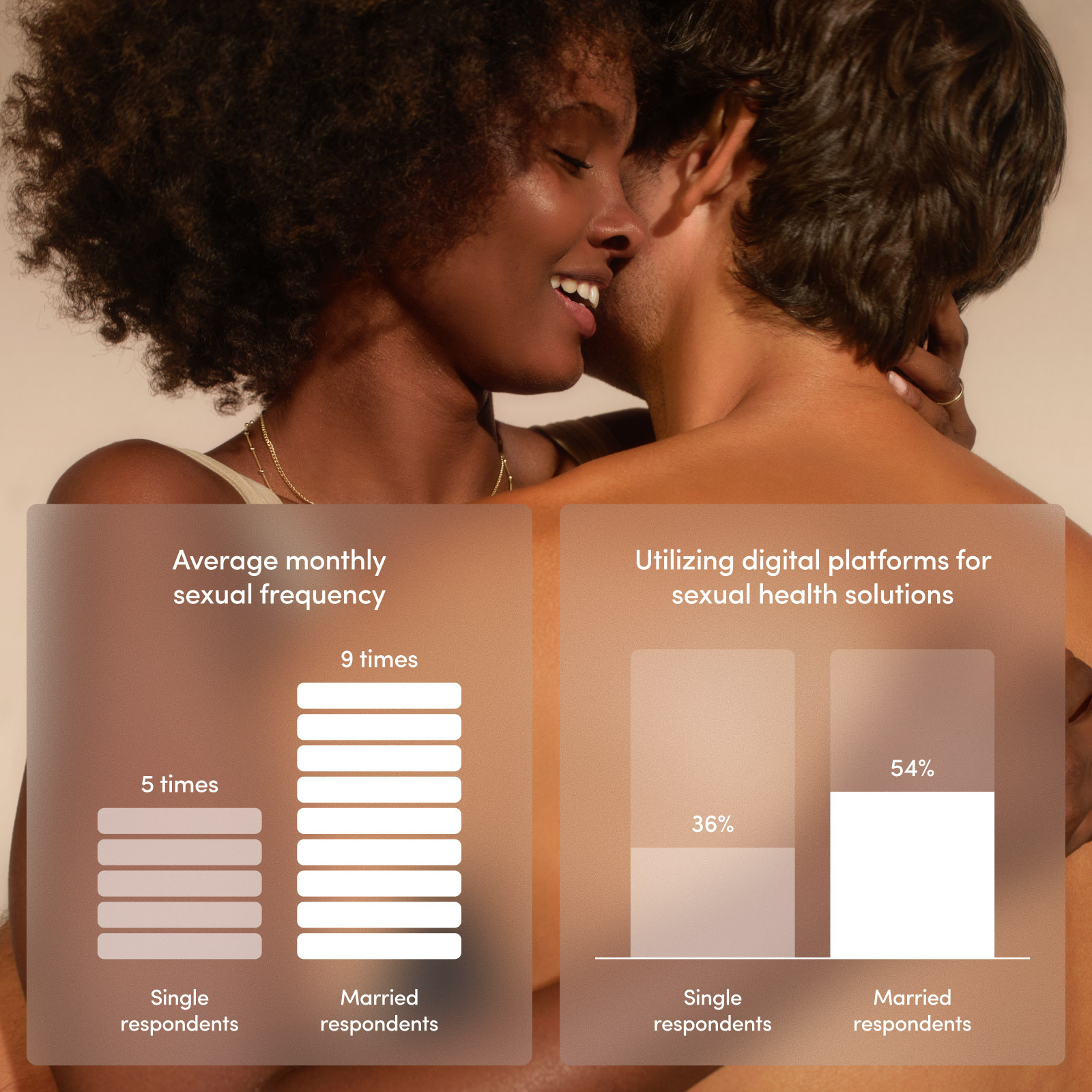
It turns out that emotional resonance, not just a new face, can be the primary driver of desire. While singles are navigating the talking stage, married couples are getting busy. In fact, married respondents have sex nearly twice as often as singles (9 times a month vs. 5 times) and are almost twice as likely to describe their sex life as "Wild: The best it’s ever been." Married respondents also lead in sexual confidence (73%), outpacing singles by 11 percentage points.
Maintaining this satisfaction and frequency isn't just about emotional connection, it’s impacted by physical readiness as well. A thriving sex life requires addressing the physical hurdles that often go unspoken. For many, the "wild" side of marriage is sustained by partners proactively treating conditions like low testosterone or menopause before they become barriers to intimacy. In fact, 54% of married respondents are utilizing digital platforms for sexual health solutions compared to just 36% of singles.
Stability and safety also fuel the fire because they create the space for experimentation. Our insights show that as married couples age, they don't just stay active, they know what works.
In fact, 51% of married respondents say their sexual performance overall has improved as they’ve gotten older, as compared to just 37% of singles. When you trust your partner, the fear of judgment vanishes. And that trust also extends to the clinical side of the bedroom. Clinicians often see that couples who navigate changes in libido or performance together—rather than suffering in silence—find that addressing sexual health concerns is an act of intimacy in itself. By removing the physical roadblocks that get in the way of pleasure, couples clear the path for the deeper connection they crave.
{inline-gallery}
Parenthood, The Unlikely Libido Boost
Perhaps the most surprising finding from the survey involves parents. While the tired parent trope is real, it doesn't seem to have dampened sex drive. Parents reported they are more likely than non-parents to identify as "sexual" (41.5% vs. 29%). Going further, parenthood and age aren't barriers to intimacy; they appear to be catalysts. Parents reported a significant surge in sexual confidence as they get older, with 56% noting a greater ease in reaching orgasm, nearly double the 30% reported by non-parents. This is echoed by the 63% of parents who agreed that sex has actually improved postpartum.
For parents, time is a luxury, which makes the quality of intimate time paramount. However, that time is often under siege; 91% of parents report that external factors, from the presence of children to their immediate living environment, impact their sex lives. They are also increasingly turning to modern care, from sexual health to hormonal support, to ensure that when parents do have a moment to themselves, physical discomfort or performance anxiety doesn't stand in the way. In fact, a striking 95% of parents (both moms and dads) reported that hormone treatment has had a positive impact on their sex lives, significantly outperforming non-parents at 80%.
Notably, because parents and non-parents in this survey are nearly the same average age (38.4 vs. 39.4), it suggests that age is not the reason for the data shifts. Parenthood itself is clearly the catalyst for increased sexual confidence and a higher adoption of modern health solutions.
At the end of the day, the data is clear: intimacy thrives when it’s grounded in a caring, committed connection. By treating sexual health as a priority rather than a taboo, couples can ensure their best sex of their lives isn't a memory from their twenties, but a reality of their thirties, forties, fifties, and beyond.