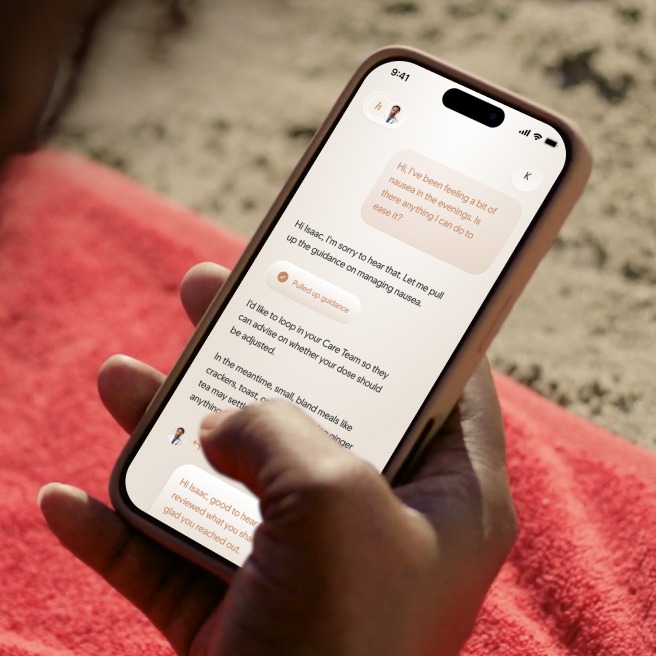
Building on Labs AI and AI on the Hers platform, we are now rolling AI-native care out to Hims weight loss members, enabling them to partner with AI and their providers to achieve better health.
The Closed Loop
We’re transitioning our platform to AI-native care by building it around a closed loop: a system that remembers customers’ context, learns from outcomes, and continuously gets smarter and more valuable for customers and clinicians over time.
In previous telehealth models, a customer with nausea would need to report it manually, determine if it had a connection to their last dose increase, and communicate with support teams who couldn’t advise them. Then, they would get forwarded to a clinician, only to wait hours for a message back and have to explain their situation all over again.
Our closed loop model is different, faster, and more seamless. When the customer chooses to use our AI tool and reaches out, the AI clinical engine knows their dose and treatment day, and that they haven’t reported this symptom before. It responds with an informed question about severity and either provides non-clinical direction or escalates straight to a provider. The customer now has an action plan and consistent follow-ups to check on their progress. The learnings from this outcome feeds back into the system, closing the loop and helping it get smarter for the next customer.
This is the moat. While legacy telehealth struggles to iterate and foundation models are becoming commoditized, closed loop systems create advantages that benefit customers and are nearly impossible to recreate.
From Advice to Action
General-purpose LLMs are built around advice. Our AI clinical engine is built around action.
That distinction carries real weight. If you're managing your health with a generic LLM, you first have to carry the burden of context. You’re re-explaining your history, your treatment, and your goals every time you open a new chat, all because you’re not sure what the model remembers and what it doesn’t. Then, you’re left with the burden of action, deciphering how to turn LLM advice into a next step, a scheduled appointment, a call to your doctor. When it comes to closing that loop – bringing all the pieces together – you’re on your own.
That’s the gap we’re closing. The AI clinical engine has persistent memory, a record that starts the moment a customer consents and opts in, and stays with them through intake, treatment planning, weigh-in results, and conversations with their Care Team. That shapes their app experience and includes information that is:
Every real outcome, whether a symptom resolved, a dose adjusted, or progress toward a goal, then feeds back into the overall system, sharpening it for the next customer while honoring each user’s privacy in the process.
No general-purpose LLM has this. It can't. The ability to carry context and enable action only exists inside a platform that's actually delivering access to care.
.jpg)
Accountable by Design
As the platform manages real customer interactions, an integrated safety layer helps keep AI responses safe, current, and personal.
The AI clinical engine reviews each patient’s record against this layer, with our team monitoring outputs for anomalies and working to reduce potential errors or bias in the guidance it surfaces. Each AI response customers receive is:
And, before any new version of our AI clinical engine goes live for customers, its outputs are run through a five-layer evaluation system, including offline red-teaming, a runtime protection classifier, and human-in-the-loop auditing at every step. Each layer is designed to catch a mistake before it affects someone's care.
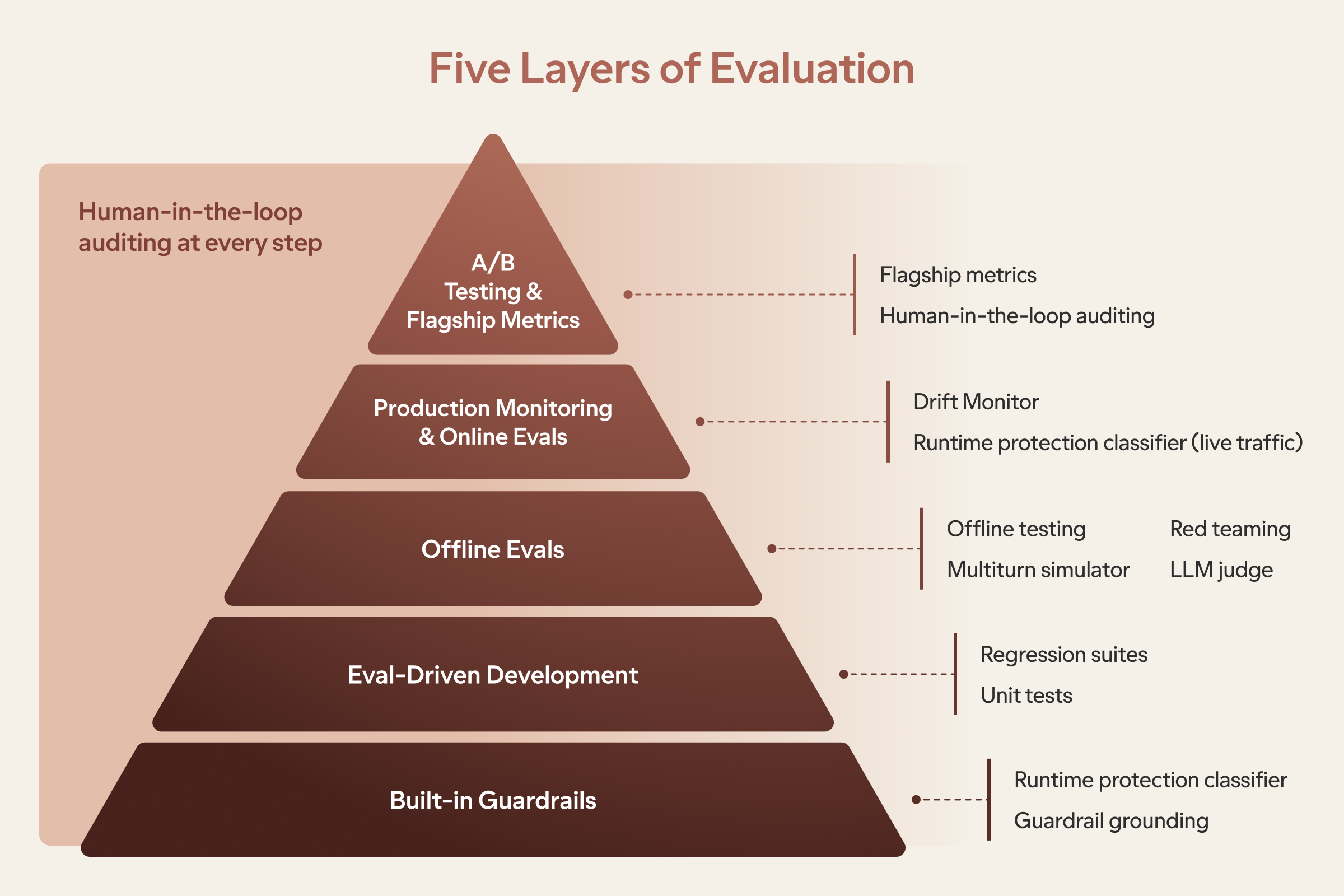
Our engineers run simulated multi-turn customer conversations scored against pass/fail criteria our clinical team defines. These are full exchanges, not single prompts. And the bar isn't set by the engineers, it's set by the clinical leaders responsible for patient outcomes.
Every round of feedback gets converted into objective evals that drive the next iteration, whether from auditors reviewing live conversations, from drift signals in production, or from the Care Team. Every version of the system is accountable to the one before it.
AI Informs, Clinicians Decide
Clinicians remain an essential part of care. By providing context and direction on non-clinical questions, the AI clinical engine puts clinicians in the right place at the right time. It connects them to customers who need the help their specific expertise can provide, elevating time spent on clinical decisionmaking.
That’s why the AI clinical engine’s routing logic is designed to hand off to a Care Team the moment a case needs human judgment. It ensures clinicians stay central in the care process.
As we continue building our AI-native care platform, the clinical trust, closed-loop data, and a care operation we’ve built around each customer will evolve alongside it. That's the foundation, and it's what builds better, more intelligent care.
*"First," "first-of-its-kind," and "only" refer to this specific combination: a single company that owns the entire care journey — intake, access to provider care, pharmacy fulfillment, and ongoing support — while embedding AI throughout that journey in one continuous experience, including support for providers. Based on publicly available information about generally available U.S. telehealth and digital health offerings as of July 2026. Not a claim about clinical outcomes.
When you choose to use the AI tool in the app, you, your Care Team, and AI share one conversation. The tool's responses are AI generated and can make mistakes. AI responses do not reflect a provider’s clinical interpretation or constitute a medical diagnosis. A licensed provider is always available to answer questions or discuss next steps.
Cautionary Note Regarding Forward-Looking Statements
This communication includes forward-looking statements within the meaning of Section 27A of the Securities Act of 1933, as amended and Section 21E of the Securities Exchange Act of 1934, as amended. These forward-looking statements can be identified by the use of forward-looking terminology, including the words “anticipates,” “expects,” “intends,” “plans,” “decides,” “may,” “will,” “likely,” “potential,” “future,” “over time,” “coming,” “hope,” or “should,” or, in each case, their negative or other variations or comparable terminology. There can be no assurance that actual results will not materially differ from expectations. Such statements include, but are not limited to, the rollout, availability, functionality, adoption and performance of the AI-enabled care experience and related platform features; the availability and distribution of the Hers smart scale to eligible members; the expected benefits of integrating AI into the clinical care experience for customers and providers; and our ability to enhance personalization, engagement, clinical support and customer outcomes through these offerings. These statements are based on management's current expectations, but actual results may differ materially due to various factors.
Forward-looking statements are neither historical facts nor assurances of future performance. Instead, the forward-looking statements contained in this communication are based on our current expectations, assumptions and beliefs concerning future developments and their potential effects on us. Future developments affecting us may not be those that we have anticipated. These forward-looking statements involve a number of risks, uncertainties (some of which are beyond our control) and other assumptions that may cause actual results or performance to be materially different from those expressed or implied by these forward-looking statements. These risks and uncertainties include, but are not limited to, the timing and success of the rollout, availability and adoption of the AI-enabled care experience and related platform features; the availability, distribution and customer adoption of the Hers smart scale; our ability to successfully develop, deploy and maintain AI-powered technologies and integrate them into our platform and clinical workflows; the accuracy, reliability and performance of AI-generated outputs and their acceptance by customers and providers; changes in the application, interpretation and enforcement of healthcare, consumer protection, privacy or artificial intelligence laws and regulations applicable to our business; and our ability to realize the anticipated benefits of these new products and features, and other factors described in the Risk Factors and other sections of our most recently filed Quarterly Report on Form 10-Q, our most recently filed Annual Report on Form 10-K, and other current and periodic reports we file from time to time with the Securities and Exchange Commission.
Should one or more of these risks or uncertainties materialize, or should any of our assumptions prove incorrect, actual results may vary in material respects from those projected in these forward-looking statements. The forward-looking statements contained in this communication are made only as of September 24, 2026. We undertake no obligation (and expressly disclaim any obligation) to update or revise any forward-looking statements, or to update the reasons actual results could differ materially from those anticipated in the forward-looking statements, whether as a result of new information, future events or otherwise, except as may be required under applicable securities laws. By their nature, forward-looking statements involve risks and uncertainties because they relate to events and depend on circumstances that may or may not occur in the future. We caution you that forward-looking statements are not guarantees of future performance and that our actual results may differ materially from those made in or suggested by the forward-looking statements contained in this communication.
.jpg)